

To meet strict effluent treatment requirements set to take effect in 2022, the City of Emporia upgraded its wastewater treatment plant in 2019. Using a progressive design build process, the city was able to reduce costs while complying with the impending regulations ahead of schedule.
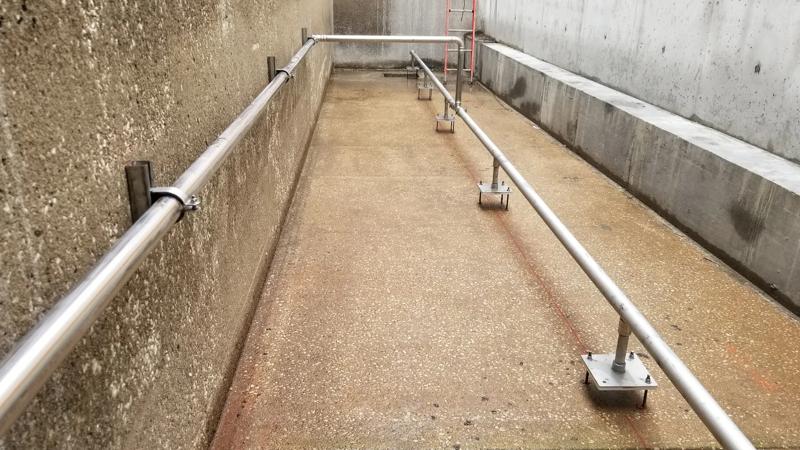 BioMix linear nozzle headers are well suited for rectangular tank geometry.
$50.000
BioMix O&M savings
$75.000
BioCycle-D energy savings
Challenge
The design-build team of Burns & McDonnell and CAS Constructors worked collaboratively to provide improvements to meet the upcoming discharge standards. Their primary goal was to upgrade and expand the plant’s conventional activated sludge process to an integrated fixed film activated sludge (IFAS) process with aerobic sludge digestion.
Solution
Process equipment procurement packages were issued to evaluate and select the most cost-effective technologies. The design team evaluated the performance, experience, and quality of numerous compressed gas mixing system manufacturers before selecting EnviroMix’s BioMix compressed gas mixing system to mix the biological nutrient removal (BNR) selectors in the secondary treatment process. Separately, they compared the process flexibility, operational costs, and total cost of ownership of aerobic sludge digestion technologies before selecting the EnviroMix’s BioCycle-D optimized aerobic digestion process for the project.
BioMix™ system in BNR selectors
The IFAS process was selected to allow reuse of the existing aeration basins, reconfiguring them with separate anaerobic, anoxic, and deoxygenation selectors for BNR. It also enabled the city to meet the discharge regulations, including those for 10 mg/l effluent nitrogen and 1.0 mg/l phosphorus. The design team’s selection of the BioMix system was based on energy efficiency, process optimization, and cost minimization.
- The configuration of the selectors would have required walkway and platform access along the length and across the width of the selectors to install and maintain mechanical mixing alternatives. However, given the design flexibility offered by the BioMix system, access walkways and platforms along the basins were not required, thereby significantly reducing the construction cost of the system.
- The large aspect ratio of the basins would have required more than a dozen mechanical mixers to uniformly mix the basin contents. With BioMix, only a duty and standby compressor were required to provide the mixing energy for the entire system, significantly reducing system maintenance and construction cost.
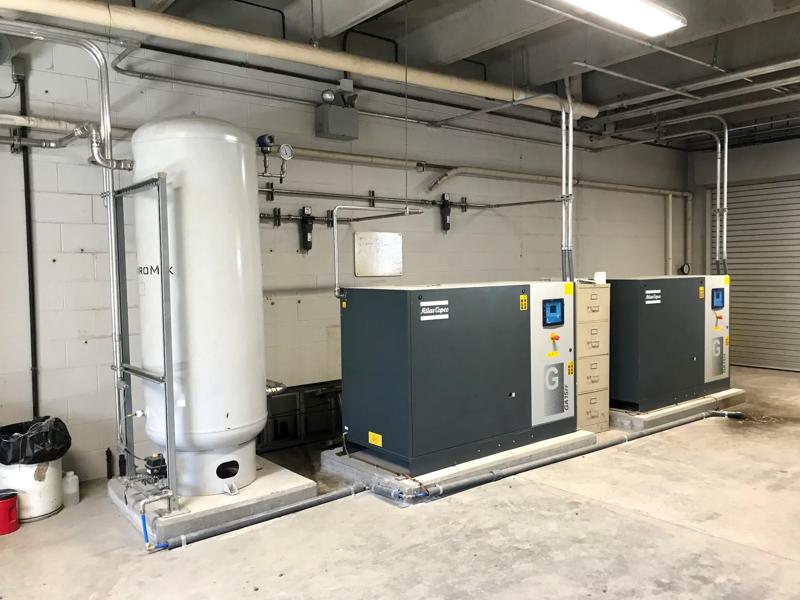 BioMix compressors and receiver are located indoors for ease of maintenance.
BioCycle-D™ process for aerobic sludge digestion
Conventional aerobic digesters use diffused aeration for both mixing and process oxygen demands. This leads to over-aeration, uncontrolled nitrification, depletion of alkalinity, and increased energy consumption. BioCycle-D controls and optimizes the digestion process, providing energy savings and improved sludge digestion through automated process control. BioCycle-D offered the flexibility that this project demanded.
- The upgraded aerobic digestion system utilizes a pre-existing 27’ deep anaerobic digester that was converted to an aerobic digester and a new 18.5’ deep aerobic digester that is about 50% greater in capacity. Even though the sludge loading to the two digesters is dissimilar, as is the operating depth, the BioCycle-D process control system aerates and mixes both digesters to produce optimal process conditions.
- Both digesters have deep conical hopper bottoms, making it virtually impossible to completely mix the tanks with just a diffused aeration system. The BioMix Compressed Gas Mixing System was installed below the aeration system to ensure bottom-up mixing all the way to the bottom of the cone, thereby eliminating the large dead volume that would result in sludge deposition and digester upsets due to septic conditions.
The BioCycle-D system is packaged as an integrated solution with the inherent flexibility to accommodate a wide range of operational conditions.
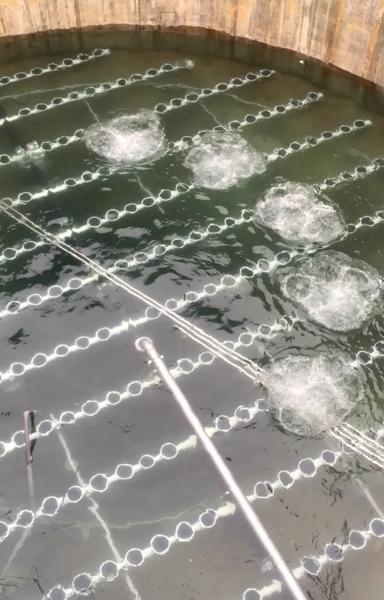
BioCycle-D decouples aeration from mixing.
Results
Compared to the other mixing technologies, the BioMix system provided the lowest total cost of ownership, enabling the City of Emporia to realize $50,000 in annual O&M savings versus submersible mechanical mixers.
Additionally, compared to the other aerobic digestion technologies, BioCycle-D provided the lowest total cost of ownership, enabling the city to achieve $75,000 annual energy savings versus conventional diffused air mixing designed at 30 scfm/1000 ft3 of tank volume.
-
BioMix Compressed Gas Mixing Systems
EnviroMix’s BioMix™ Compressed Gas Mixing Systems provide uniform mixing of tank contents by firing programmed, short duration bursts of compressed... -
BioCycle-D Optimized Aerobic Digestion Process
EnviroMix’s BioCycle-D™ Optimized Aerobic Digestion Process provides ideal conditions for aerobic sludge digestion and the reduction of organic...