

The City of Abilene’s water is provided by three nearby treatment plants — Grimes WTP, Northeast WTP, and Hargesheimer WTP. The three treatment plants have a combined maximum treatment capacity of 46 million gallons per day and treated ground storage capacity of 23.3 million gallons.
The city is a contract customer of the Colorado River Municipal Water District for water out of the O.H. Ivie Reservoir. A pump station and distribution pipeline bring approximately 12 million gallons of raw water per day from the reservoir into the Hargesheimer WTP.
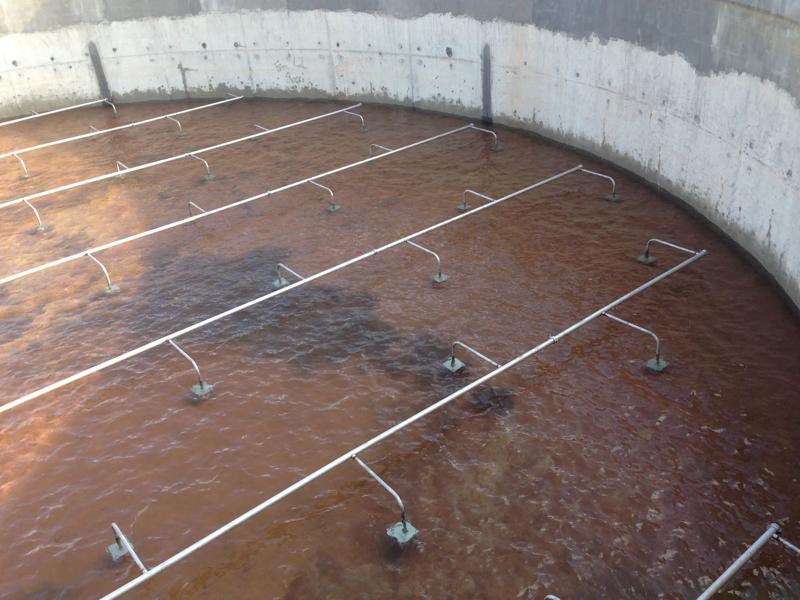 Uniformly distributed nozzles headers provide bottom-up mixing.
0,30
hp/1,000 FT3 mixing efficiency
50
% energy savings
Challenge
Raw water from local surface water reservoirs undergoes complete treatment — including flocculation, sedimentation, filtration, and disinfection — in order to meet state and federal regulations for water quality. Water quality is closely monitored in all phases of production and treatment by state licensed operators.
The Hargesheimer WTP was designed to utilize conventional flocculation and sedimentation with an additional treatment process of micro-filtration/reverse osmosis. The flocculation and sedimentation process produces ferric sludge. The settled sludge is pumped to a 400,000-gallon sludge holding tank, where a mixing system fluidizes the sludge prior to being fed to a belt filter press for dewatering and disposal.
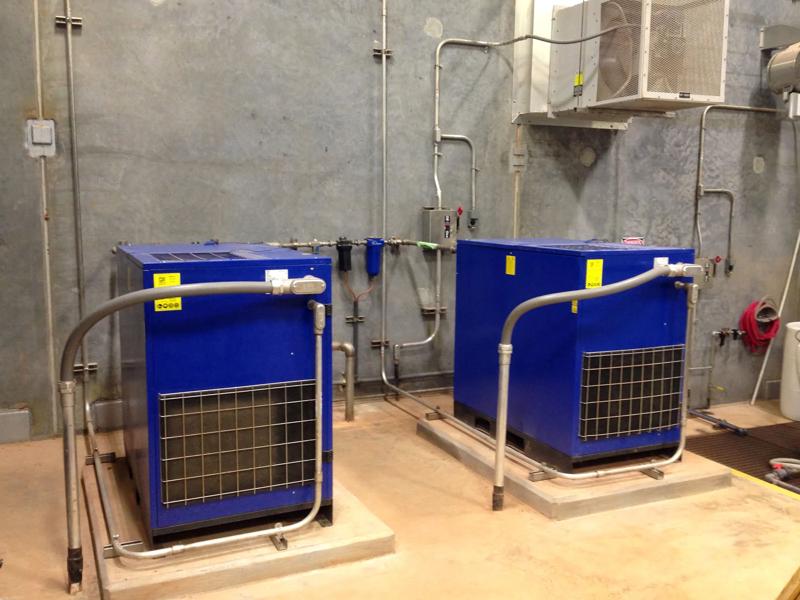 Compressed air is provided by duty and standby compressors.
Solution
Providing 50% energy savings versus coarse bubble aeration mixing technology, EnviroMix’s AquaBlend Potable Water Mixing System was selected by design engineer Enprotec/Hibbs & Todd to mix the ferric sludge produced from the flocculation and sedimentation process at the Hargesheimer WTP.
AquaBlend was the ideal choice for this application for several reasons:
- Ferric sedimentation sludge can be relatively dense, so using a conventional approach to mixing via mechanical mixers or diffused aeration can result in high energy costs. In contrast, with its uniformly distributed nozzle headers and bottom-up mixing regime, AquaBlend reduces energy consumption.
- Conventional technologies can also result in high maintenance costs — with mechanical mixers, seals do not last in the abrasive sludge environment; with diffused air mixing, plugging of the diffusers frequently occurs. Conversely, the high pressure firing of the AquaBlend nozzles via the 100 psi compressors eliminates in-tank maintenance.
- Moreover, as the sludge is pumped to the belt filter press, the operating depth in the holding tank decreases to only a few feet. This would decrease mixing effectiveness with conventional mixing technologies, whereas AquaBlend can accommodate variable operation depths.