

Grid Arrangement
-
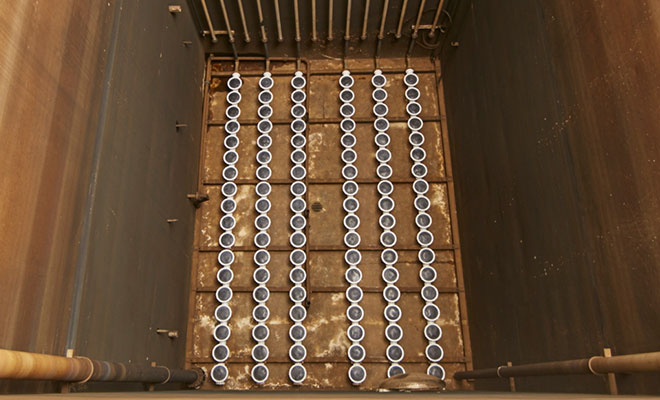
Grid Arrangement Factors to Consider
Balancing cost, efficiency, and engineering factors is crucial when it comes to designing an aeration grid.
Longer Headers and Shorter Manifolds in Aeration Grid Design
While there definitely is a science to aeration grid design, there is also an artful balancing act between cost, efficiency, and engineering factors every time a design is proposed.
The basic premise guiding aeration grid design is that longer headers and shorter manifolds result in the most cost effective use of materials. That is why most ‘stock’ designs are rectangles with long headers. There are instances when longer manifold and shorter headers are more appropriate for the plant, but rotating the grid is typically made on a case-by-case basis.
Diffuser Density and its Impact on Oxygen Transfer Efficiency in Fine Bubble Diffusers
One important factor influencing oxygen transfer efficiency is how even the diffusers are spread out across the floor of the tank. Highly efficient aeration systems spread the air more evenly over the tank floor. The measure of the evenness, or how evenly air is spread over the tank floor, is captured in a number called At/Ad, or the ratio of the area of the tank floor to the area of the diffusers, where a lower At/Ad indicates a higher density of diffusers.


Calculating Diffuser Density in Aeration Tanks
To calculate At/Ad, the tank area in square feet (or square meters) is divided by the membrane area in square feet (or square meters). In the case of a 9” diameter disc diffuser, the area is 0.41 ft2 (0.038 m2) per diffuser. Typical diffuser densities will range from approximately 4.5-20, with an allowable range of 4-40 without the need for special consideration.
The percent floor coverage is simply the inverse of At/Ad, so an At/Ad of 4.0 will equate with a floor coverage of 25%, while an At/Ad of 40 equates to 2.5% floor coverage.
High density grids are generally considered zones with an At/Ad of less than ~5, while low density grids are zones with an At/Ad of greater than ~15. Any grid design with an At/Ad greater than 40 is not considered ‘full floor coverage,’ and therefore would be prone to solids separation and tank stratification unless supplemental mixing is incorporated.
