

Materials of Construction
-
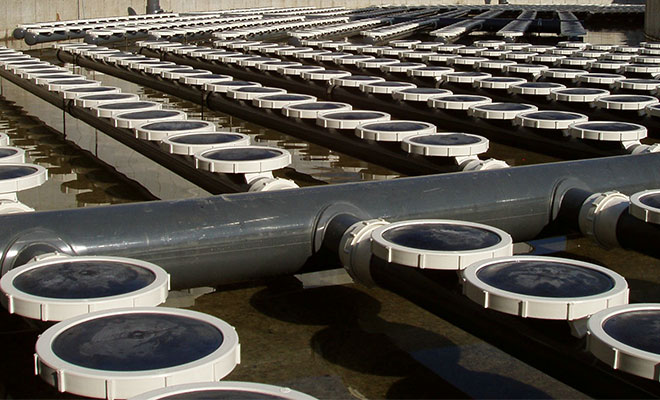
Selecting materials for your aeration system.
In almost all cases, the standard materials used to construct a fine bubble aeration system are stainless steel, PVC, and EPDM.
Types of Materials Used in Aeration System Construction
Wastewater is a harsh environment for equipment. In addition to the force of the moving water and vibrating equipment, there are numerous chemicals that can be aggressive to certain aeration system components. Sometimes the presence of these chemicals is known, but most of the time they have not been identified. As a result, the material from which the aeration system is made needs to be robust for construction site installation, strong enough to withstand moving water forces, corrosion resistant to both typical and atypical waste constituents, and cost effective to produce in large quantities.
In almost all cases, the standard materials used to construct an aeration system are:
•Stainless steel
•PVC
•EPDM
Chemical resistivity charts are available and can be referenced if there are any questions as to whether a certain material is compatible with a specific wastewater constituent. Additionally, the best way to determine material longevity is to pilot a sample of the material in the wastewater. While this may be more time intensive, it will ensure fewer problems once the equipment is in operation.
Contact the manufacturer if a particularly exotic wastewater requires alternative materials that differ from standard materials. Non-standard materials for certain applications in specialized waste streams are available.
Stainless Steel
Stainless steel is used for all of the metallic components of the aeration system including:
• Droplegs
• Support assemblies
• Anchor bolts
• Flange hardware
• Clamp coupling
Aeration manufacturers typically offer 304SS as their standard material because it offers the strength, corrosion resistance, and affordability required. However, 316SS is also available for additional corrosion resistance if there is a high chloride concentration or if there is another component of the influent that is more aggressive to 304SS.
For the dropleg, thin walled stainless steel is used for its efficiency at cooling the air before it reaches the lower PVC dropleg. The most common thicknesses used are Sch 5 and Sch 10, depending on the diameter of the pipe.

PVC
Polyvinyl chloride (PVC) is used for the grid piping, joints, diffuser holders, and diffuser retainer rings. The advantages of PVC are:
• Light weight
• Inexpensive
• Readily available
• Repairable in field
• Commonly used in wastewater applications
However, the disadvantages of PVC include:
• Susceptible to degradation by UV light
• Vulnerable to melting at high temperatures
• Breakable
In order to mitigate UV light degradation, a minimum of 1.5% TiO2 is generally recommended in the PVC components. A concentration of 2% TiO2 is preferred for additional protection in 4” diameter pipe due to the thinner walls.
As for temperature concerns, care should be taken during installation to avoid temperatures greater than 140°F (60°C) such as: not placing the piping on blacktop, not covering the equipment with tarps, and trying to keep the equipment in the shade. In an effort to protect against hot blower air, a cooling loop can be included in the design if necessary. If high temperatures are still a concern, CPVC is available for especially high ambient air/water temperatures or deeper tanks.
Regarding PVC pipe wall thickness, all pipe larger than 4” dia (100 mm) is a minimum of Schedule 40 with the option of going to Sch 80. For pipe that is 4” dia the wall thickness depends on the method used to attach the diffuser holder to the pipe. For holders that are solvent or ultrasonically welded to the pipe, a wall thickness of 0.125”/3.18mm (SDR 33.5) is the minimum recommended for depths less than 19 ft. (5.8 m) submergence. For submergences greater than 19 ft. (5.8 m), a minimum thickness of 0.173”/4.39mm (SDR 24) is recommended due to the increased static pressure. Holders that are mechanically attached to the pipe generally require a greater thickness to account for the increased stress on the pipe. In that case, a minimum of Sch 40 pipe (0.237”/6.02mm thickness) is required. Regardless of the type of holder used, Sch 40 or Sch 80 (0.337”/8.56mm thickness) pipe is available for the distributor pipe.

EDPM and Other Available Materials
EPDM is used for membrane disc diffusers. The name EPDM is a generic term for hundreds of different blends of various elastomer compounds. As a consequence, not all EPDM is the same, and many years of testing and piloting went into the creation of the specialized EPDM formulas used in wastewater applications. Even between manufacturers, the blend of EPDM used for the diffusers are different. As a result, differences in longevity and transfer efficiency are to be expected between manufacturers.
Other materials are also used in aeration systems such as:
• Natural rubber for joint gaskets
• Fused aluminum oxide for ceramic disc diffusers
• Polyurethane for fine bubble strip diffusers