Installed Diffuser Height
-
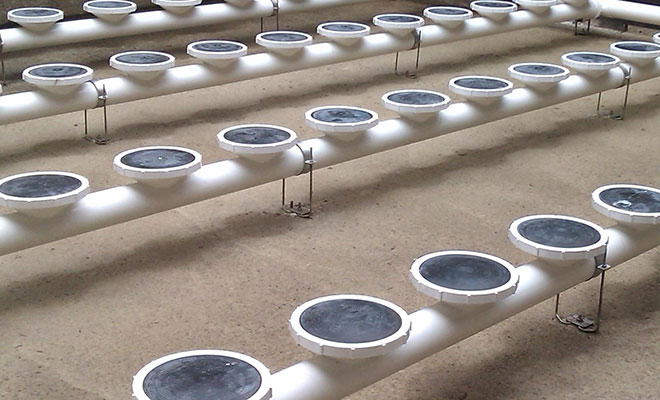
How high should diffusers be positioned?
The height the diffusers are from the tank floor is critical in determining other design factors for the plant, including air rate and pressure.
Diffuser Submergence Best Practice
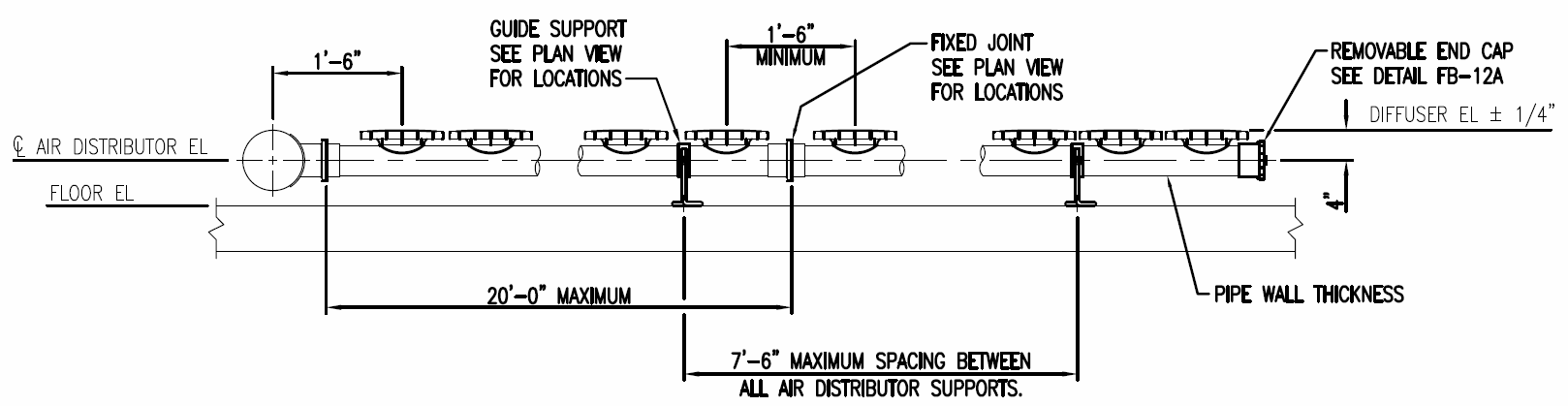
Since oxygen transfer efficiency (OTE) is directly related to submergence, it would make sense that a diffuser manufacturer would locate the diffusers as close to the tank floor as possible. While that is true to an extent, best practice dictates that the piping and diffusers should not be located too close to the tank floor. Piping and diffusers too close to the tank floor could result in the creation of eddies and low velocity spots around the aeration equipment, leading to deposition of solids and an anoxic condition within the accumulated sludge.
However, locating the equipment slightly off of the floor means that an acceptable scouring velocity can be maintained between the piping and the floor – preventing solids build-up. Positioning the diffuser surface above the floor requires balancing:
- OTE
- Support height limitations
- Floor slope
- Clearance under the pipe
- Blower pressure limitations (if any)
In general, the height of the diffusers is determined by the following factors:
- Manifold diameter – For standard in-line manifolds, the centerline of the manifold is the same as the centerline of the distributor pipe. From that, the diffuser surface elevation is a fixed distance above the centerline of the distributor pipe. The typical way of determining the centerline elevation of the manifold involves first selecting a manifold diameter that does not exceed the maximum recommended air velocity through the pipe.
- Manifold length – The next step is to decide if a flange is required by looking at the length of the manifold. If a flange is required it will cause the entire grid to move slightly upward to accommodate the additional clearances necessary to fit the flange.
- Floor slope – The effect of any slope in the floor must also be accounted for because it may be possible to set the manifold into the deeper part of the tank – increasing the possible submergence.
- Dropleg location – The dropleg location can also impact diffuser height because it determines how the grid can be oriented.
The final submergence can be calculated after these variables have been finalized and the grid arranged.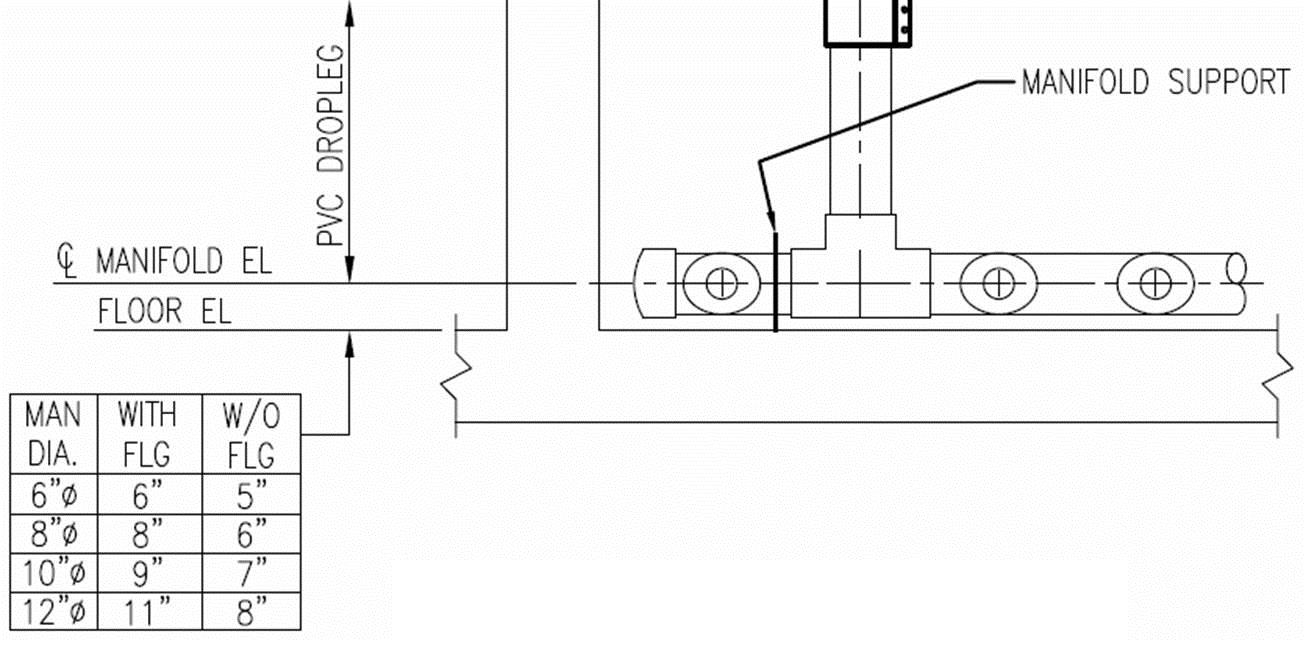


Calculating Diffuser Density in Aeration Tanks
To calculate At/Ad, the tank area in square feet (or square meters) is divided by the membrane area in square feet (or square meters). In the case of a 9” diameter disc diffuser, the area is 0.41 ft2 (0.038 m2) per diffuser. Typical diffuser densities will range from approximately 4.5-20, with an allowable range of 4-40 without the need for special consideration.
The percent floor coverage is simply the inverse of At/Ad, so an At/Ad of 4.0 will equate with a floor coverage of 25%, while an At/Ad of 40 equates to 2.5% floor coverage.
High density grids are generally considered zones with an At/Ad of less than ~5, while low density grids are zones with an At/Ad of greater than ~15. Any grid design with an At/Ad greater than 40 is not considered ‘full floor coverage,’ and therefore would be prone to solids separation and tank stratification unless supplemental mixing is incorporated.